Showing posts with label Jabula. Show all posts
Thursday, November 5, 2020
In Exile
Eight years ago, I posted this double compilation with extensive notes at Electric Jive. The response was fantastic and the post soon became one of the most visted at EJ and remained popular for a number of years. You can now listen to the audio of each compilation while scrolling the text via Mixcloud widgets embedded below. Please enjoy!
South Africa outside!
For the past ten years I have been exploring through a number of varied projects the idea of a history of South Africa outside itself. The premise of the research involves the idea that individuals (as well as artifacts) leave the country for a range of complex reasons and thereafter exist in an external space. Often these individuals (and the histories they embody) remain unrecognized or forgotten in South Africa. My goal has been to mine and collate the information and to return it in some form back to a South African audience. In many ways the compilation featured here today is part of one of these projects and features a cross-section of mostly South African music in exile.
For purposes of definition, exile music here covers a thirty year period from 1959 to 1990, during the heart of the apartheid years. This survey is by no means comprehensive, nor is it representative of all South African exile artists or even their ‘best’ work. Rather it is a collection of some of my favorite, more personal tunes. Tunes that for me capture some of the darker but also more ecstatic moments of exile.
The alienation, isolation of the foreign experience is evident on many tracks, especially the solo performances. But at the same time, so are fragments of cultural memory, various phrasings, quotes of the majuba sounds of the 1950s, that instantly recall a distant home. Often the fragments give way to moments of ecstatic joy and build in strength to challenge the darkness.
The task of compiling a limited set of tracks on this theme has been difficult — there is so much good music out there and these volumes could potentially continue for some time. In any event, I have tried to select albums that are generally harder to come by or tracks that are perhaps somewhat unusual. While European and US jazz enthusiasts might be familiar with some of these recordings, many have been unavailable and remain unheard in South Africa.
Miriam Makeba does not feature on this compilation (an earlier posting offers comprehensive coverage of her contributions and can be viewed here at Electric Jive) yet her singular importance as an artist in exile is undeniable. Makeba is the first major South African artist to record and establish a significant anti-apartheid profile. Her importance in constructing an empathetic image for disenfranchised South Africans in the international context cannot be overstated.
Significantly Makeba's first album was issued within months of the Sharpeville massacre in 1960. And while there is no specific mention of the tragedy in the liner notes, Makeba’s condemnation of the apartheid government is evident in these lines: “Though she tries many styles, she never sings the Afrikaner songs of white South Africa. (‘When Afrikaners sing in my language,’ she says, ‘then I will sing in theirs.’)” Interestingly, this text can only be found on the US, Canadian, New Zealand and later Israeli copies of the album. On British and all other versions it has been edited out.
Makeba’s exit from South Africa is slightly predated by the Golden City Dixies, who toured Europe in early 1959 and then in December ten members, including Danny Williams, Harold Jephtah, Brian Isaacs and Ronald Chetty, applied for political asylum in Sweden.
Another major event that catalysed a stream of artists leaving the country was the international production of King Kong. In February 1961 artists including Gwigwi Mrwebi, Jonas Gwangwa, the Manhattan Brothers travelled with the cast to London, but decided not to return when the show ended, leaving a gaping hole in the South African music industry.
Dollar Brand (Abdullah Ibrahim) and Sathima Bea Benjamin would leave in January 1962. They were later joined by Johnny Gertze and Makhaya Ntshoko. With the help of Ibrahim, the Blue Notes, including Dudu Pukwana, Mongezi Feza, Johnny Dyani, Chris McGregor, Louis Moholo and Nikele Moyake, left in 1964 to play at the Antibes Jazz Festival in France. They decided to remain there and in Switzerland, before eventually moving to London. Moyake, suffering from serious homesickness, decided to return to South Africa in 1965 but soon died from a brain tumor.
This blog post cannot begin to describe the emotional, psychological, cultural, and political complexity of the South African musician in exile. Though apparently free of apartheid, these artists endured alienation and isolation. Many suffered from debilitating mental and physical stress and many died in exile never returning home. These complexities however are explored through the music.
Johnny Dyani describes their situation in the liner notes of his album African Bass: “I would like to tell my people. That we think and cry for them now and then; it is not easy for us on this side of the world, but together we will have our freedom: Power to the People: yours in music.”
If anyone is interested in a theoretical analysis of exile in South African jazz I would recommend Michael Titlestad’s very dense essays on the subject in his book Making the Changes. For an easier read, Maxine McGregor’s account of the Brotherhood of Breath is excellent.
Perhaps Louis Moholo sums it up best in an interview: “To be in exile is a motherfucker.”
IN EXILE - Volume 1
(Flatinternational, Electric Jive, FXEJ 7)
1) BRIAN ISAACS / RONALD CHETTY – B.C. – 1967
(Isaacs, Chetty; Afrikanska Rytmer EP, Expo Norr, RIKS EP 2, Sweden)
My Swedish is really not very good (actually non-existent) but according to the liner notes, this unusual EP was recorded in Stockholm, Sweden on November 24, 1967. The disc appears to by the product of an academic tour that Brian Isaacs and Ronald Chetty undertook amongst various schools in the region. Their program called “Afrikanska Rytmer” involved teaching various aspects of traditional African rhythm instruments. Ebrahim ‘Brian’ Isaacs was born in Vrededorp, a suburb of Johannesburg in 1939 and Chetty in Kimberly, 1933. Isaacs became part of the touring variety show African Jazz in 1955 and then both joined Majiet Omar’s famed Golden City Dixies in 1956. The group toured extensively throughout Southern Africa before becoming the first South African ensemble to travel internationally in April 1959. During Christmas of that same year 10 members of the group including Isaacs and Chetty decided to remain in Sweden as political refugees. According to Muff Anderson, Isaacs became a cabaret performer in Sweden and to my knowledge put out at least one, privately pressed, solo LP, Bayete, sometime in the 1970s. A track from that album is featured on the Flatinternational vol.1 compilation.
2) BRÖTZMANN / MILLER / MOHOLO – Special Request for Malibu (extract) – 1980
(Brötzmann, Miller, Moholo; Opened But Hardly Touched, FMP 0840/0850, West Germany)
The German horn-man, Peter Brotzmann joins South African bassist Harry Miller and drummer Louis Moholo in a contorted explosion of almost unlistenable free jazz. Recorded in Berlin on November 5th/6th 1980, Opened, But Hardly Touched is the second of two hard-to-find albums by this trio — the first being The Nearer the Bone, the Sweeter the Meat (FMP 0690, 1979).
For me the free jazz captured on this track and the one that follows it, Pukwana’s Yi Yole, are iconic representations of alienation through dissonance. No other tracks on this “Exile” compilation are harder to listen to! The references to the iconic majuba sound of the 1950s, familiar to much South African jazz in exile, is significantly absent in these compositions. There are moments in the recording that remind me of the contemporaneous, industrial sounds of Einstürzende Neubauten’s classic, debut LP Kollaps (ZickZack, 1981) or even Steve Albini’s later groups Shellac or Rapeman.
In many ways Brotzmann’s acerbic aesthetic dominates the sound of trio. At times his horn literally sounds like a screaming human voice. Brotzmann’s 1968 seminal, second album Machine Gun is considered by many to be a cornerstone of European free jazz and is described by one comment on YouTube in this way: “This is the most ugly, abrasive piece of music ever. Cool!”. Significantly the only (until recently) live recording of Machine Gun was included on Brotzmann’s CD titled Fuck De Boere — Dedicated to Johnny Dyani (Unheard Music, ALP 211CD).
Harry Miller opens the extract of “Malibu” (the full version is 22’20”) with a frenetic but quiet scraping of his upright bass that recalls for me Ennio Morricone’s metallic treatments in the opening fifteen minutes of Sergio Leone’s Once Upon A time in the West.
Moholo completes the trio on drums and in a 1991 Wire interview describes his experience of free jazz: “When we came here I started hearing some other vibes. I was away from South Africa and away from chains. I just wanted to be free, totally free, even in music. Free to shake away all the slavery, being boxed into places – one, two, three, four – and being told you must come in after four […] From then on I just played free.”
3) PUKWANA / BENNIK / MENGELBERG – Yi Yole (extract) – 1978
(Pukwana; Yi Yole, ICP 021, Netherlands)
Recorded between September 2nd - 5th 1978, Yi Yole features Dudu Pukwana on alto sax and whistle; Misha Mengelberg (Dutch) on piano and Han Bennik (Dutch) on drums, clarinet, trombone and viola. In 1967 Mengelberg co-founded the Instant Composers Pool or ICP, an organization to promote Dutch avant-garde music and also the label on which this recording was issued. Pukwana’s sax treatments here while not as abrasive as Brotzman’s in the previous track are still remarkably strained and yet at times do return to the melodic.
4) A TENT – Seven Years Part 2 (Abundance) - 1981
(Gavin Povey; Six Empty Places, Red Cherry, BRED 17, France)
In the same year that Dudu Pukwana and Zila issued their funky first LP on Jika records, Pukwana also recorded with A Tent featuring Gavin Povey on keyboards. This is a very interesting album. My first impressions of the LP were that is was a type of ambient jazz album in the spirit of Brian Eno, but as I got into it I recognised that it had elements that came far closer to the industrial sounds of Cabaret Voltaire or even Throbbing Gristle, both contemporaries of this group. Pukwana plays saxophone on a number of tracks. More on the album at Mutant Sounds.
5) JOHNNY M. DYANI – South Afrikan (extract) – 1979
(trad. arr. Dyani; African Bass, Red Record, VPA 149, Italy)
Recorded in Milan, November 14th 1979 this sparse album includes Clifford Jarvis on drums. The vocal track here features Dyani moving towards an ecstatic interpretation of the traditional song Bayeza Kusasa. His version comes ten years after Jonas Gwangwa’s brilliant take on the same tune featured on his 1969 album, Who (Ngubani)? For more examples see Matsuli.
6) CHRIS MCGREGOR – The Bride / Ududu Nombambula (extract) – 1977
(Pukwana, McGregor; In His Good Time, Ogun, OG 521, UK)
Recorded in Paris on November 18, 1977. This solo LP is one of three issued by McGregor and captures a loneliness through absence of other performers, and yet is distinctly still warm.
7) HUGH MASEKELA – Ingoo Pow-Pow – 1972
(Caiphus Semenya; Home is where the Music is, Chisa / Blue Thumb, BTS 6003, USA)
Recorded in London in January 1972 with Masekela on flugelhorn, Dudu Pukwana on alto sax, Larry Willis on Piano, Makhaya Ntshoko on drums, Eddie Gomez on acoustic bass. The cover features drawings by South African artist, Dumile Feni.
8) HARRY MILLER – Homeboy – 1974
(Miller; Children At Play, Ogun, OG 200, UK)
According to the liner notes by Pallo Jordan, Harry Miller was born in Johannesburg in 1941 and came to study music in London in 1961. He soon was a prominent figure in the London jazz scene performing with Chris McGreogor’s Brotherhood of Breath and the Mike Osborne Trio, amongst others. Together with his wife, Hazel, Miller co-founded Ogun records in the early 1970s with the goal of documenting the open-minded music of London at that time. Though Miller died in a car accident in the Netherlands in 1983, Hazel Miller continues to run the label and issues great music to this day.
Ogun Records first release was a live recording of the Brotherhood of Breath at Willisau (OG 100) featuring Miller on bass. Children at Play was Ogun’s second issue and Miller’s first solo LP. The album features Miller playing all instruments including double bass, flute and percussion on a multi-track recording. One of my favorites from this album is Homeboy, a very warm reference back to South Africa, with an almost maskanda like treatment of the double bass.
9) DOROTHY MASUKA – This Land is Mine – c1967
(Pat Boone; Africa in Revolutionary Music, LSM Records, R 1, Canada)
In the 1950s, Dorothy Masuka was one of the leading recording artists in South Africa. As producer for Troubadour Records, Cuthbert Matumba was open to recording songs that sometimes contained critical commentary, and the company occasionally drew visits from the Special Branch of the police, who often confiscated masters and copies of records. In 1961, Masuka wrote and recorded the song Lumumba, in response to the outrage over the execution of the newly elected Congolese leader. The South African Special Branch took note and confiscated the master and began searching for Masuka. In the meantime, she returned to Bulawayo and remained there on the advice of Troubadour. After the incident, Masuka was declared persona non grata by the South African authorities and was forbidden from re-entering the country. She remained in exile from South Africa for the next 31 years.
Masuka would spend the following years travelling and performing in Africa and Europe. In 1965 she returned to Rhodesia for a performance. After hearing that the Ian Smith Government was planning to arrest her, she moved to Zambia where she remained in exile for the next sixteen years as a flight attendant for Zambian airways.
The track featured here is a moving fragment of Pat Boone’s This Land is Mine and on the LP is mixed together with a number of other freedom songs from around Africa.
10) THE SWAPO SINGERS – Power to the People – late 1970s
(Kaujewu, Haipinge; One Namibia One Nation, SWAPO Department of Information, 6812 258, Netherlands)
One of my favorite recent finds, this LP features some of the most beautiful freedom songs from Namibia. Stylistically many of the tracks remind me of those by the 1940s guitarist, George Sibanda. Power to the People (not the Lennon version) alludes to a number of struggles worldwide including Vietnam, Angola, Mozambique, Guinea-Bissau and Cuba. Contributors to the album include Jackson Kaujewu (who also does all the arrangements), Dan-Hafeni Haipinge, Martha Eliser, Albertina Heita, Sackey Schikwambi, Nick Nambahu and Frieda Kaurimuje. The album appears to be recorded in Amsterdam, but alas there is no date, but I assume it is some time in the late 1970s. More on this album at Dial Africa.
11) THE ZULUS (AFRICA ‘68) – Uyaz’ Gabisa – 1968
(Caiphus Semenya; Africa ’68, UNI, 73030, USA)
While the original record is poorly credited, a compilation CD reissue (The Chisa Years) of some of the tracks from this LP reveal the group in that case to be simply called The Zulus. I am also assuming that all the tracks on Africa 68 are by the same band and if so, then the line-up on this song would include Mumsie Gwangwa, Ernest Moholmi, John Sithebe, Paul Makgoba, Philemon Hou, Letta Mbulu, Caiphus Semenya, all on vocals; with Bruce Langhorn on guitar; and John Cartwright on bass.
On April 2nd 1964 Alan Paton’s play Sponono opened on Broadway at the Cort Theatre in New York. Directed by Krishna Shah, the play included musical arrangements by Gideon Nxumalo and the cast featured amongst others Philemon Hou as Ha’ Penny, Doudlas Ndikho Xaba as an imbongi or praise singer, Caiphus Semenya as one of the reformatory Boys and Margaret Mcingana (Singana) as a member of the choir. According to Miriam Makeba, in her biography, the performance on Broadway was picketed. In her words “people thought Sponono was just some white play with Uncle Tom black people in it. They boycotted it. They did a mock funeral parade and carried a coffin symbolizing that Sponono had died.” But Makeba goes on to say that the performers that came were genuine actors and musicians. The show was a “flop” and the cast returned to South Africa, but some of the artists remained including Semenya, Hou and Xaba. Makeba assisted them in finding scholarships to study music and an apartment in New York. In many ways their arrival in New York gave Makeba and Hugh Masekela a vital community away from home.
Caiphus Semenya had been dating Letta Mbulu, before he came to the US and Makeba made arrangements for her to come out and perform at the Village Gate in New York. Mbulu arrived at the end on 1964. She later married Semenya. Mumsie Gwangwa is of course married to Jonas Gwangwa, who left South Africa in 1961 with the King Kong cast.
In 1966 Letta Mbulu’s first single titled Walkin’ Around was issued on the Columbia label. Letta and the Safaris featured a possible similar line up with Hugh Masekela, Jonas Gwangwa, Caiphus Semenya, Stewart Levine, Charlie Smalls, Eric Gale, John Cartwright, Herbie Lovell, Mamsie Gwangwa and Ernest Mohlomi. Check out the single on the Flatinternational vol.1 compilation. For more on this record see Doug Payne's article.
12) AMANDLA – Sasol – 1982
(uncredited; Amandla, Melodiya, C60 18207, USSR)
Amandla, like Mayibuye before it, was an anti-apartheid group formed by the cultural arm of the ANC in exile. Mayibuye was established in early 1975 while Amandla began to slowly come together towards the end of the 1970s, though the two groups are unrelated. In the early years the group limited its performances to ANC camps and various venues around Luanda, Angola. Once a Scandinavian tour had been organized for 1980, trombonist, Jonas Gwganwa was called in to assist with arrangements. Gwangwa soon became the group’s artistic director.
In all Amandla recorded four albums, two in Sweden and two in the USSR. Sasol comes from the first Russian release and their 2nd album overall, issued in 1982. The Soviet Union was sympathetic to Anti-Apartheid causes and supported the ANC in exile with training and shelter. Though not fully credited, some of the performers on this album include M. Khuze, B. Kgoale, E. Choncho, L. Tikwane, S. Kumalo. View some of the covers here at Matsuli.
Sasol was a major state-owned oil refining company in South Africa. The lyric translation and more details can be viewed here at Flatinternational.
13) SOUNDS OF SOWETO – Mama Ndiyalila – 1983
(Caiphus Semenya, arr. Victor Williams; Wie Lange Noch Dieses Leid?, Misereor 631383, Germany)
Recorded in Hamburg, Germany, this 1983 anti-apartheid record included Linda Conco, Sam Hlatwayo, Steve Khala, Wally Loate, Dumisane Mabaso, Josh Makhene, Sonti Mwdebele with arrangements by Victor Williams and Makhene. Williams also performs on piano with Dudu Pukwana's Spear on the album Flute Music (see volume 2 below).
14) DISTRICT SIX – Etlon-Tu – 1987
(Brian Abrahams; To Be Free, Editions EG, EGED 53, USA)
District Six on this record includes Brian Abrahams on drums, percussion and vocals; Chris McGregor on piano and vocals; Jim Dvorak on trumpet and vocals; Bill Katz on bass; and Harrison Smith on tenor and soprano sax, flute and bass clarinet. An earlier album, titled Akuzwakale, issued in 1984, also includes Mervyn Africa on piano and Russell Herman on guitar.
15) JABULA – Let Us Be Free – 1974
(Bahula, Ranku; Jabula, Caroline, CA 2004, UK)
In 1973, Julian Bahula, originally of the Malombo Jazz Makers, decided to go into exile and moved to the UK. Initially he toured with the South African group Hawk but soon started putting together a new group — Jabula — with Lucky Ranku and an international cast of musicians including a number of South Africans. Jabula worked closely with the African National Congress and the Anti-Apartheid movement and subsequently a number of their records were banned in South Africa.
This track comes from their first album recorded in September 1974. For an extensive discography of Julian Bahula and Jabula check out flatint.
16) SOUTH AFRICAN FREEDOM SONGS – iBande Nge Lami – 1965
(uncredited; This Land Is Mine, Folkways, FH 5588, USA)
Finally we end volume one with a ‘freedom song’ featured on one of the earliest collections of South African protest music. Issued on the Folkways label in 1965, this album includes material that was sent to Moses Asch from an ANC training camp in Tanganyika (now Tanzania). A funky version of this same tune, iBande Nge Lami, which roughly translates as The Belt is Mine, can be heard on Miriam Makeba’s 1970 album Keep me in Mind. View more information about the Folkways album plus translations of all the song lyrics here at Flatinternational.
IN EXILE - Volume 2
(Flatinternational, Electric Jive, FXEJ 8)
1) DOLLAR BRAND (ABDULLAH IBRAHIM) – Hush – 1970
(traditional; African Sun, Spectator, SL 1025, Denmark)
A solo record by Abdullah Ibrahim recorded from May 9th to 10th, 1970 in Copenhagen, Denmark. This track is somewhat unique in that it is not very often that you hear Ibrahim singing let alone playing the drum. Certainly a beautifully, strained version of Hush, the almost gospel tune, made famous by Miriam Makeba and the Skylarks in 1958. According to Lars Rasmussen, African Sun is one of the rarest Ibrahim albums as a fire at the Spectator Studios destroyed the original master tapes as well all remaining copies of the LP.
2) BROTHERHOOD OF BREATH – Uqonda – 1981
(McGregor; Yes Please, In and Out, IaO 1001, France)
After planning to avoid Brotherhood of Breath tracks on this compilation (especially the Ogun material that has all recently been re-issued), I could not resist including this lugubrius tune from one of their more obscure, later LPs: Yes Please. Recorded June 1st and 2nd 1981, in Angoulême, France, my only gripe with this wonderful piece is that the recording of Peter Segone’s trumpet is way too loud and piercing — it can really hurt your ears! To some extent I have tried to remedy this, but I suppose conceptually there is something interesting about listening to a track so beautiful and yet at moments so physically painful.
The Brotherhood of Breath, formed by Chris McGregor in London, June 1970, in many ways was an attempt to reconstitute in exile a type of Castle Lager Big Band. Made up of South African exiles drawn from the Blue Notes and a number of leading London free-jazz performers, the group recorded their first LP in 1971 on RCA’s Neon label. From there they continued with at least six more records spread over RCA, Ogun, then later this record on In and Out and finally Virgin’s Venture label. Since then a number of live and bootleg recordings have been issued posthumously on CD.
On Yes Please only McGregor is present from the original Blue Notes line up, though the group at this point does also include South Africans: Ernest Mothle on bass, and Brian Abrahams on drums and percussion. McGregor would later perform with Abraham's group District Six (see Volume 1 above).
3) DYANI / TEMIZ / FEZA – Dear Africa – 1972
(Dyani; Music For Xaba Vol. 2, Sonet, SNTF 824, UK)
The session that was recorded in Stockholm, Sweden on November 2nd, 1972 produced two fantastic albums that were issued eight years apart. Remarkably some of my favorite tracks like Dear Africa and Mighty Blues were not included on the first installment. The trio consisted of Johnny Dyani on bass and piano, Mongezi Feza on trumpet and Okay Temiz, a classically trained percussionist from Turkey, on drums. Both Dyani and Feza left South Africa with the Blue Notes in 1964.
4) JOE MALINGA QUINTET – Zadibana – 1981
(Malinga; One For Dudu, Meteor, MOR 32018, Switzerland)
A tribute album to Dudu Pukwana, this recording was made in Innsbruk, Austria on November 7th 1981. The line-up here includes Malinga on alto sax, congas and shakers; René Widmer on tenor sax and oboe; Johnny Taylor on piano; Hami Hämmerli on bass; and Churchill Jolobe on drums and claves. For a discography of Joe Malinga check out Matsuli.
5) AUTHORITY – Bayabaleka – 1987
(Authority; Against Again Apartheid in South Africa, Suisa/Nuke’s Presence, A 97, Switzerland)
A really well arranged and well recorded, late anti-apartheid album featuring classic protest songs like Mello Yellow, Shosholoza and Oliver Tambo. There are moments in the instrumentation on this record that for me hint at a future BLK JKS. One has to hunt for the name of the group on the LP but eventually you discover that it includes Aubrey Molefe, Smal Ndaba, Aubrey Radebe, all on vocals; Gabriel Magos on keyboards and guitar; Jürg Planta on drums; Hopi Hopkins on percussion; Christian Ostermeyer on saxes and flutes; and Hilary Williams on bass. The lyrics for Bayabaleka or Running Away translate as:
Running Away
Towards the South
In fear of the spear (Mkonto)
Let them all leave
He-Um
6) AMANDLA – Ekhaya Bakulindile – 1980
(traditional, Amandla; First Tour Live, Afrogram, AGIS 002, Sweden)
This track is one of my favorites of the whole compilation. It opens with a vocal introduction reminiscent of the many soul jive sounds of the Movers and other groups of the mid 1970s. Though the content here, in contrast, is bleak and political. The song then moves into a hymn that builds towards what I would describe as an ecstatic moment.
The track comes off Amandla’s third LP First Tour Live recorded in Stockholm, October 1980 and issued on the Afrogram label in Sweden in 1983. Amandla as mentioned earlier developed out of the cultural arm of the ANC in exile and follows to some extent the project of the earlier group, Mayibuye. Though uncredited it is possible that Jonas Gwangwa may have been responsible for arrangements on this album. For more information on both these groups, I would highly recommend Shirli Gilbert’s excellent essay “Singing Against Apartheid” in Composing Apartheid, edited by Grant Olwage.
7) DUDU PUKWANA AND SPEAR – Flute Music 1+2 – 1974
(Mongezi Feza; Flute Music, Caroline, CA 2005, UK)
Simply a classic! Though I recognize that Mongezi Feza’s Flute Music opens (part 1) and ends (part 2) the album in a manner that approaches a concept album, the split tracks also reminded me of the way many long-form bump jive tracks were broken up to meet the shorter requirements of a 45 rpm single. Thus I could not resist splicing together both parts of this amazing tune to make one long thirteen minute experience.
Recorded between 14th / 15th October 1974, and issued on Virgin’s Caroline label, Pukwana’s 3rd album with his group Spear includes himself on alto sax, flute, percussion and voice; Feza on trumpet, flute congas, percussion and voice; Victor Williams on piano, electric piano and voice; Pete Cowling on bass; and John Stevens on drums.
8) LOUIS MOHOLO OCTET – You Ain’t Gonna Know Me Cause You Think You Know Me – 1978
(Mongezi Feza; Spirits Rejoice, Ogun, OG 520, UK)
Louis Moholo is the last remaining of the six Blue Notes that left South Africa in 1964 – all others have died in exile. Remarkably, though recording on countless albums including those with the Chris McGregor Group, Brotherhood of Breath and many other collaborations, Spirits Rejoice is his first as band leader. Recorded in London on January 24th 1978, the line-up includes Moholo on drums; Evan Parker on tenor sax; Kenny Wheeler on trumpet; Nick Evans on trombone; Radu Malfatti on trombone; Keith Tippet on piano; Johnny Dyani and Harry Miller on bass. A classic Mongezi Feza tune!
9) NDIKHO XABA AND THE AFRICAN ECHOES – Zulu Lunchbag – c1970s
(Gideon Nxumalo; 45 rpm, Shange, #2005, USA)
Ndikho Xaba and the African Echoes do a wonderful example of Gideon Nxumalo’s Zulu Lunchbag on this hard-to-find single.
Multi-instrumentalist and actor, Douglas Ndikho Xaba, was born in Natal in 1934. In 1964 Xaba came to the US as part of Alan Paton’s play Sponono which opened at the Cort Theatre in New York on April 2nd. Directed by Krishna Shah, the play included musical arrangements by Gideon Nxumalo and the cast featured amongst others Philemon Hou as Ha’ Penny, Xaba as an imbongi or praise singer, Caiphus Semenya as one of the reformatory Boys and Margaret Mcingana (Singana) as a member of the choir. After the show closed much of the cast returned to South Africa, but some of the artists including Semenya and Xaba, remained. Miriam Makeba assisted them in finding scholarships to study music and an apartment in New York. In many ways their arrival in New York gave Makeba and Hugh Masekela a vital community away from home.
Xaba is possibly most well known for his tune Emavungwini popularized by Miriam Makeba on her 1968 album Makeba!, but first featured on Hugh Masekela’s 1965 album Grrr. Xaba and his group the Natives are also responsible for the super rare, spiritual jazz LP, Ndikho and the Natives, issued on the Trilyte label in 1969.
10) OKAY TEMIZ / JOHNNY DYANI – I’m Muslim Man – 1976
(Dyani; Witchdoctor’s Son, Yonka, YCSLP 5013, Turkey)
This hard-to-find, middle-eastern flavored LP features some really excellent collaborations between, Turkish percussionist, Okay Temiz and, bassist, Johnny Dyani. The album is split evenly with compositions by Temiz on side A and those by Dyani on side B. Others on the recording include Saffet on clarinet and violin; Gunnar on saxophone; and Oguz on electric bass. Listen to the full album here.
11) DUDU PUKWANA AND ZILA – Ziyekelani – 1983
(Mervyn Africa, Pukwana; Life in Bracknell and Willisau, Jika, ZL 2, UK)
In 1978 Pukwana founded the record label Jika and put out at least three albums with his newly formed group Zila. Ziyekelani is from their second album and features Pinise Saul on vocals. The album consists of live recordings from the Bracknell and Willisau Jazz Festivals in 1983. The Zila line-up on these occasions included: Pukwana on alto, soprano sax and whistle; Pinise Saul on vocals and cabassa; Harry Beckett on trumpet, flugelhorn; Django Bates on keyboards; Eric Richards on electric bass; Paul Gamblin on guitar; Churchill Jolobe on drums; and Thebe Lipere on congas and percussion.
12) THE MANHATTAN BROTHERS - Gumboot – 1963
(Manhattan Brothers; Concert of Zulu Folk Songs, Tropitone, CP 27, UK)
The Manhattan Brothers left South Africa with the cast of the international production of King Kong in February 1961. After the show ended, Nathan Mdledle, Joe Mogotsi and Rufus Khoza decided to remain in the UK. There they continued recording as the Manhattan Brothers but with Walter Loate replacing Ronnie Sehume. Recorded at Cecil Sharpe House, this album appears to be the only live recording of the group and features Sol Klaaste on piano. An edited version of the album was re-issued on CD as Freedom Songs and accompanies Joe Mogotsi’s autobiography, Matindane, edited by Lars Rasmussen. Their 1950s vocal style seems somewhat out of place in the context of London at this time, which reinforces a strange sense of displacement on this LP. My favorite track, which is quite unusual, finds them performing a gumboot dance at the close of the concert.
13) GERARD SEKOTO – Sing Low – late 1950s
(traditional; Negro Spirituals EP, La Voix De L’Esperence, France)
This rare and unusual piece of art history features a number of spirituals by South African painter, Gerard Sekoto, who went into exile to France in 1947. Joe Mogotsi in his autobiography has this account of first meeting the artist in Paris:
“When we saw him, he was living alone in a dilapidated flat with very few creature comforts. Paintings were strewn all over the floor, and he was in a disorganized state. Although his health was failing, he still made an effort to welcome us, and questioned us intently about whether things had changed at home and if there had been any improvement. We went out and bought wine and food which we shared with him while we talked about old times. It was a very heart warming experience.”
Unable to make a living from his painting he survived by performing. According to Wikipedia he composed at least 29 songs that were published between 1956 and 1960 by Les Editions Musicales. Sekoto died outside Paris in March 1993. Today his paintings are some of the most expensive and it is no surprise that this particular EP sold for £2,880 at auction some years ago — the most I have ever seen any South African related record go for!
Wednesday, November 2, 2011
Julian Bahula, Malombo and Jabula — Discography
Trying to unpick a history (in vinyl issues, anyway) of one of South Africa's most memorable Afro-jazz-blues group's—Malombo—can at times be a difficult task. Often on eBay, one will find records by Malombo without the group's indomitable guitarist and leader, Philip Tabane, or sometimes one may see a record by the Malombo Jazzmen or the Malombo Jazz Makers. Occassionally Abbey Cindi may be the leader or Gabriel Thobejane performs on the "Malombo drums". Sometimes it is Julian Bahula at the helm with Lucky Ranku on guitar.
Essentially the broad history of Malombo can be broken up into two separate groups that often used the same name for different recordings by each group. Though starting as a single group, the two threads soon split apart, one wing with Philip Tabane, the other with Abbey Cindi and Julian Bahula. To unpack this history I have put together two discographies, one for Philip Tabane, the other for Julian Bahula. Though many others were involved, Tabane and Bahula are the two members of the original group that seemed to continue separately each thread of Malombo music. (Cindi and Ranku, of course, played major roles in what I am loosely calling the "Bahula" thread.) Today's post focuses on "Julian Bahula and Malombo" as well as his later group Jabula. The "Philip Tabane and Malombo" discography can be viewed here.
Some of these albums as well as their re-issues have fetched amazing prices on auction at eBay and so I have put together a discography that attempts, at least in part, to identify the many different issues. If you have an album or an issue not featured in this list please let us know and we can add it to the discography.
Yvonne Huskisson in her Bantu Composers of Southern Africa has Abbey Cindi and Philip Tabane forming a group called the Lullaby-Landers in 1961 or 1963, depending on which entry you read. In 1963 the group changed their name to the Malombo Jazz Men which included Julian Bahula on a set of "African drums". He had originally come from the Vlakfontein City Council Band. As Huskisson puts it, Malombo's aim was "to produce a new sound in Jazz by introducing African drums and African drum beats and an African traditional sound into a Progressive-Jazz trio." The group was hugely successful, winning a number of competitions most notably the 1964 Castle Lager Jazz Festival at Orlando Stadium. The trio made their first recordings with "Radio Bantu" that same year and soon a debut, studio LP—Castle Lager Jazz Festival 1964—was issued by EMI. The B-side of the album also included the Early Mabuza Quartet.
This classic record featured the original line-up of the Malombo Jazz Men (sometimes Jazzmen) with Philip Tabane on guitar, Abbey Cindi on flute and Julian Bahula on the "Malombo drums". The group would soon split somewhere around 1966.
After the break-up, Tabane began working with Gabriel 'Mabi' Thobejane and continued recording under the name Malombo Jazzmen and then later simplified it to just Malombo.
Bahula and Cindi teamed up with Lucky Ranku on guitar and formed the Malombo Jazz Makers, sometimes featuring Hilda Tloubatla (from the Mahotella Queens) on vocals. Their first LP after the break-up was simply titled Malompo Jazz (with a "p"). They issued roughly three albums as the Malombo Jazz Makers with Gallo and then in 1971 recorded an album with 3rd Ear Records as Malombo.
Essentially the broad history of Malombo can be broken up into two separate groups that often used the same name for different recordings by each group. Though starting as a single group, the two threads soon split apart, one wing with Philip Tabane, the other with Abbey Cindi and Julian Bahula. To unpack this history I have put together two discographies, one for Philip Tabane, the other for Julian Bahula. Though many others were involved, Tabane and Bahula are the two members of the original group that seemed to continue separately each thread of Malombo music. (Cindi and Ranku, of course, played major roles in what I am loosely calling the "Bahula" thread.) Today's post focuses on "Julian Bahula and Malombo" as well as his later group Jabula. The "Philip Tabane and Malombo" discography can be viewed here.
Some of these albums as well as their re-issues have fetched amazing prices on auction at eBay and so I have put together a discography that attempts, at least in part, to identify the many different issues. If you have an album or an issue not featured in this list please let us know and we can add it to the discography.
Yvonne Huskisson in her Bantu Composers of Southern Africa has Abbey Cindi and Philip Tabane forming a group called the Lullaby-Landers in 1961 or 1963, depending on which entry you read. In 1963 the group changed their name to the Malombo Jazz Men which included Julian Bahula on a set of "African drums". He had originally come from the Vlakfontein City Council Band. As Huskisson puts it, Malombo's aim was "to produce a new sound in Jazz by introducing African drums and African drum beats and an African traditional sound into a Progressive-Jazz trio." The group was hugely successful, winning a number of competitions most notably the 1964 Castle Lager Jazz Festival at Orlando Stadium. The trio made their first recordings with "Radio Bantu" that same year and soon a debut, studio LP—Castle Lager Jazz Festival 1964—was issued by EMI. The B-side of the album also included the Early Mabuza Quartet.
This classic record featured the original line-up of the Malombo Jazz Men (sometimes Jazzmen) with Philip Tabane on guitar, Abbey Cindi on flute and Julian Bahula on the "Malombo drums". The group would soon split somewhere around 1966.
After the break-up, Tabane began working with Gabriel 'Mabi' Thobejane and continued recording under the name Malombo Jazzmen and then later simplified it to just Malombo.
Bahula and Cindi teamed up with Lucky Ranku on guitar and formed the Malombo Jazz Makers, sometimes featuring Hilda Tloubatla (from the Mahotella Queens) on vocals. Their first LP after the break-up was simply titled Malompo Jazz (with a "p"). They issued roughly three albums as the Malombo Jazz Makers with Gallo and then in 1971 recorded an album with 3rd Ear Records as Malombo.
In 1973, Julian Bahula decided to go into exile and moved to the UK. Initially he toured with the South African group Hawk but soon started putting together a new group — Jabula — with Lucky Ranku and an international cast of musicians including a number of South Africans. The South African contingent of the group included Julian Bahula on drums and percussion, Lucky Ranku on guitar, Pinise Saul on vocals; Ernest Mothle (from the Early Mabuza Quartet and the Heshoo Beshoo Group) on bass, and sometimes Busi Mhlongo on vocals and Dudu Pukwana on saxophone. Jabula worked closely with the African National Congress and the Anti-Apartheid movement and subsequently a number of their records were banned in South Africa.
Certainly Bahula forming Jabula with Ranku could be viewed as a continuation of Malombo under another name. For more information on Julian Bahula and Jabula read his biography at jabulamusic.com. See also Matsuli and Wall of Sound. For more information on Malombo visit 3rd Ear Music.
DISCOGRAPHY

CASTLE LAGER JAZZ FESTIVAL 1964 (1964)
Malombo Jazz Men / Early Mabuza Quartet
Philip Tabane (guitar); Abbey Cindi (flute); Julian Bahula (drums)
• HMV, JCLP 62, RSA
• HMV (black label) JCLP 62, 2XAS 305/6, RSA (reissue)*
• HMV (blue label) JPL (M) 4019, RSA (reissue)
• Number One Records, N 9033, RSA (reissue)
• CCP Record Company, CDJPL (WB) 4041, RSA (1997, reissue)
1) Foolish Fly (Tabane)
2) Your Neighbour (Tabane)
3) Chief’s Kraal (Emkobola) (Tabane)
4) Blues for you (Tabane)
5) Zandile (Tabane)
6) Malombo Men’s Prayer (Tabane)
* Thanks to Olivier Ledure for images of the black label issue.
SABC WHITE LABEL PROMO DISC (c1964)
Malombo Jazz Men
Philip Tabane (guitar); Abbey Cindi (flute); Julian Bahula (drums)
(Tracks identical to original 1964 LP issue)
• SABC 10" acetate, RSA
1) Foolish Fly (Tabane)
2) Malombo Prayer (Tabane)
WITS GREAT HALL – LIVE (1965)
Malombo Jazz Men
Philip Tabane (guitar); Abbey Cindi (flute); Julian Bahula (drums)
• Third Ear Music, 1/4–track demo tape recording, RSA
(Logo and info sourced from 3rd Ear Music)
SABC OVERSEAS TRANSCRIPTION SERVICE (1966)
Malombo Jazzmen
Abbey Cindi (flute); Julian Bahula (drums); Lucas Ranku (guitar)
• SABC, LT 8447 (mono), RSA
1) Tribute To Birds (Cindi)
2) Tribute To Birds (Cindi)
3) Abbey’s Mood (Cindi)
4) Grab This for Me (Cindi)
5) Lullaby for Angels (Cindi)
MALOMPO JAZZ (1966)
Malombo Jazz Makers
Abbey Cindi (flute, harmonica); Julian Bahula (drums); Lucas 'Lucky' Ranku (guitar); Hilda Tloubatla (vocals)
• Gallotone (red label), GALP 1464, ABC 26181/2, RSA
• Gallo (blue label), SGALP 1464, ABC 26181/2, RSA (1972, reissue)
1) Abbey’s Mood (Cindi)
2) Lullaby for Angels (Cindi)
3) Grab this for Me (Cindi)
4) Emakhaya (Cindi)
5) Blues After Lunch (Cindi)
6) Bababelo (Cindi)
7) Intandane (Cindi)
8) A Tribute to Birds (Cindi)
9) Root of Africa (Cindi)
10) Vuma Mbari (Cindi)
11) Lousy Fever (Cindi)
12) Jikeleza (Cindi)
CHRISTMAS GREETINGS AND MUSIC OF SA (1966)
Various Artists / Malombo Jazz Men
The track here is different from the LP version and there are at least two different cover images for the EP. View the alternative cover image at Matsuli.
• Gallotone (blue label) EP, XYZ 111, ABC 26444, RSA
• Gallotone EP, XYZ 111, RSA (issued with different cover)
4) Abie’s Mood (The Malombo Jazz Men)
* Thanks to Paul Buttery for this image.
CASTLE LAGER SPECIAL EDITION (1967)
Malombo Jazzmen
Philip Tabane (guitar); Abbey Cindi (flute); Julian Bahula (drums)
(Tracks identical to original 1964 LP issue.)
• Rave 10” acetate, 235, RSA (March 1967)
1) Zandile (Tabane)
2) Emkobola (Tabane)
3) Malombo Prayer (Tabane)
4) Blues (Tabane)
MALOMBO JAZZMEN (c1967)
Malombo Jazzmen
Philip Tabane (guitar); Abbey Cindi (flute); Julian Bahula (drums)
(Tracks unknown)
• Phillips 10” acetate, C 2143, RSA
MALOMBO JAZZ MAKERS - VOL. 2 (1967)
Malombo Jazz Makers
Abbey Cindi (flute, harmonica); Julian Bahula (drums); Lucky Ranku (guitar); Hilda Tloubatla (vocals)
• Continental (red label), ZB 8162, ABC 30773/4, RSA*
• Gallo (blue label), SZB 8162, ABC 30773/4, RSA (1971, reissue)
1) Ngivulele (Cindi)
2) Udondolo (Cindi)
3) Soul of Africa (Cindi)
4) Jolly Journey (Cindi)
5) Umkhosi (Cindi)
6) Majazana (Cindi)
7) Abbey’s Body (Cindi)
8) Vukani (Cindi)
9) Hleziphi (Cindi)
10) Sibathathu (Ranku)
11) Malombi Walk (Cindi)
12) Emoubane (Cindi)
* Thanks to Olivier Ledure for the images of the original Continental issue.
NONGQUASE (1967)
Basil Somhlahlo and the African Theatre Company
Stephen Moloi (narrator); Julian Bahula, Dennis Nene (Malombo Sound)
• Quality, LTJ 223, RSA (April 1967)
1) Joy and Sadness (Somhlahlo)
2) U Loliwe (Somhlahlo)
3) Yekiinto Zabantu (Somhlahlo)
4) Qula Kwedini (Somhlahlo)
5) Manyauza (Somhlahlo)
6) Botani (Somhlahlo)
7) Nongqause Vision (Somhlahlo)
8) Isikhalo Sohlanga (Somhlahlo)
9) The Kings’s Verdict (Somhlahlo)
10) Bula Sangoma (Somhlahlo)
11) Osenyangweni (Somhlahlo)
12) Xolani Mawethu (Somhlahlo)
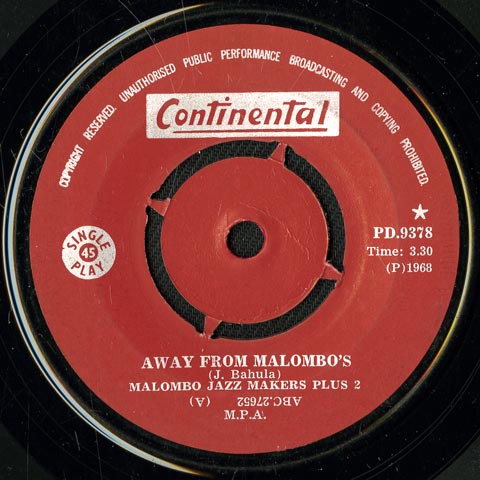
45 RPM (1968)
Malombo Jazz Makers Plus 2
• Continental (red label), PD 9378, ABC 27652/3, RSA
1) Away from Malombo's (Bahula)
2) Bahula Dithabeng (Ranku)
45 RPM (1968)
Malombo Jazz Makers Plus 2
• Continental (red label), PD 9379, ABC 27654/5, RSA
1) Maroping (Ranku)
2) Malombo Messengers (Bahula)
MUSIC SOUNDS OF AFRICA (1969)
Various Artists / Malombo Jazz Makers
Abbey Cindi (flute); Julian Bahula (drums); Lucky Ranku (guitar)
• Gallo (blue label, black corner), SGALP 1578, ABC 27784/5, RSA
• Gallo (blue label, blue corner), SGALP 1578, ABC 27784/5, RSA
14) Umkhosi (Cindi)
DOWN LUCK'S WAY WITH MALOMBO JAZZ MAKERS (1969)
Malombo Jazz Makers
Abbey Cindi (flute, harmonica); Julian Bahula (vocals, drums); Lucky Ranku (guitar)
(Sleeve notes by Aggrey Robeson Zola Klaaste.)
• Continental, SZB 8245, RSA*
1) Tribute to A. Motjoadi (Ranku)
2) Bahula Dithabeng (Ranku)
3) Gae-Mamelodi (Bahula, Ranku)
4) Sefuralong (Ranku)
5) Matshenyogo (Ranku)
6) Lucky's Way (Bahula)
* Thanks to Francis Gooding for the info on this LP.
MUSIC OF THE SPIRIT (1971)
Malombo
Abbey Cindi (flute); Julian Bahula (drums); Lucky Ranku (guitar)
• Third Ear Music, TEE 01, RSA
1) Heavens Door Steps (Cindi)
2) Birds Meet Elephant (Cindi)
3) Gae Mamelodi (Ranku, Bahula)
4) Exerpt from Ourang Outang (not listed on the labels)
5) Malombo Workshop (Ranku, Bahula)
6) Inyoni (Cindi)
7) Dikomeng (Ranku, Bahula)
8) Ungaokhala (Cindi)
* Thanks to Chris Albertyn for images of the labels.
MALOMPO JAZZ (1972)
Malombo Jazz Makers
Abbey Cindi (flute, harmonica); Julian Bahula (drums); Lucky Ranku (guitar)
(Tracks appear to be identical to original A-side of 1966 LP issue.)
• Gallo, acetate with engineering notes, GALP 1464, MA 738, RSA (3rd July, 1972)
Jabula — Discography
In 1973, Julian Bahula decided to go into exile and moved to the UK. Initially he toured with the South African group Hawk but soon started putting together a new group — Jabula — with Lucky Ranku and an international cast of musicians including a number of South Africans. Jabula worked closely with the African National Congress and the Anti-Apartheid movement and subsequently a number of their records were banned in South Africa.
JABULA (1975)
Jabula
Busi Mhlongo (vocals); Ken Eley (tenor, soprano saxes); Lucky Ranku (guitar, percussion); Ernest Mothle (bass); Graham Morgan (drums); Julian Bahula (drums); Dudu Pukwana (alto sax)
(Cover art by Dumeli Feni, recorded September 1974)
• Caroline, CA 2004, UK
• Virgin, 88645 ET, Germany
• Jabula, JBL 2002, UK (1979, reissued as Jabula Happiness)
• Pläne, 88215, Germany (1980, reissued as Let Us Be Free)
1) Jabula Happiness (Bahula, Apps)
2) Baile – They Are Gone (Ranku, Bahula)
3) Listen to me Crying (Mothle, Ranku, Apps)
4) Naledi (Bahula)
5) Badishi – Herdboys (Ranku, Bahula)
6) Thandi (Ranku)
7) Siakala – We are Sad (Bahula)
8) Our Fathers (Bahula, Apps)
9) Let Us Be Free (Bahula, Ranku)
* Images of the JBL 2002 issue sourced from Soul Safari.
45 RPM (1975)
Jabula
• Virgin, VS 118, UK (view at 45cat)
• Virgin, VS 118, UK (with large side A + B)
1) Jabula Happiness (Bahula, Apps)
2) Baile – They Are gone (Ranku, Bahula)
V (1975)
Various Artists / Jabula
(Compilation, track originally released on 1975 LP, Jabula.)
• Virgin, VD 2502, UK
• Virgin, VD 2502 (with artist list at top of front cover)
14) Baile - They Are Gone (Ranku, Bahula)
* Image sourced from Captain Beefheart Electricity.
THUNDER INTO OUR HEARTS (1976)
Jabula
Julian Bahula (drums, vocals); Ernest Mothle (bass); Dudu Pukwana (alto sax); Lucky Ranku (guitar, vocals)
(Recorded Nov/Dec 1975)
• Caroline, CA 2009, UK*
• Jabula, JBL 2001, UK (1977, reissue)
1) Thunder Into Our Hearts (Ranku)
2) Soweto My Love (Bahula)
3) Ithumelang Ba Memelodi (Bahula)
4) Tears of Afrika (Bahula)
5) Baleka – Run Away (Ranku)
6) Journey to Afrika (Bahula)
7) Harvest Part II (Bedeau)
* Image of the Caroline issue back cover sourced from The Growing Bin.
JOURNEY TO AFRICA (1977)
Jabula
(Compilation reissue of tracks from previous two LPs)
• Jabula/Gallo, BL 134, ABC 7524/5, RSA
1) Journey To Africa (Bahula)
2) Badishi – Herdboys (Ranku, Bahula)
3) Ithumeleng Ba Mamelodi (Bahula)
4) Jabula Happiness (Bahula, Apps)
5) Soweto My Love (Bahula)
6) Naledi (Bahula)
7) Baleka – Run Away (Ranku)
JABULA IN AMSTERDAM - ZUID AFRIKAANSE MUSIEK (1977)
Jabula
Julian Bahula (drums); Lucky Ranku (guitar); Mike Rose (flute, alto sax); Dave Defries (trumpet); Steve Scipio (bass); Pinise Saul (vocals); Judith De Kom (poetry); Hans Dagelet (poetry); Peer Mascini
(Live in Amsterdam in association with the Mayibuye group, the cultural arm of the ANC in exile. LP not to be confused with later UK issues of the same name. This is the album that is referred to as being banned in the SA Government Gazette featured on the cover of the Afrika Awake and In Amsterdam LPs that followed.)
• Anti-Apartheidsbeweging Nederland, AABN 177, Netherlands
1) The Promised Land (Bahula, Ranku)
2) All for One (Ranku)
3) That Day (Bahula, Ranku)
4) Herdboys (Ranku, Bahula)
5) Sorrows (Bahula)
6) Journey to Africa (Bahula)
AFRIKA AWAKE / BANNED IN RSA (1978)
Jabula
Julian Bahula (drums); Lucky Ranku (guitar); Mike Rose (flute, alto sax); Steve Scipio (bass); Pinise Saul (vocals); John Matshikiza and Judith de Kom (spoken poetry)
• Jabula, JBL 2003, UK
• Jabula, JBL 2003, UK (issued as In Amsterdam / Banned in RSA)
• Varagram, ET 27, Netherlands (issued as Afrika Awake / Verboden in RSA)
• Plane, 88154, Germany (1979, reissued as African Soul)
1) Afrika Awake (Ranku, Bahula)
2) Thunder (Ranku, Bahula)
3) Mathome (Ranku)
4) Sorrows (Bahula)
5) Soweto My Love (Bahula)
6) Soweto’s Children (Bahula)
7) Siakala (Bahula)
8) I Know My Way (Bahula, Bahula)
9) Raining in Amsterdam (Ranku)
FREEDOM YES! APARTHEID NO! (1979)
Jabula / SA Freedom Singers
Julian Bahula (Malombo drums); Pinise Saul (vocals); Mike Rose (flute, alto-sax); Lucky Ranku (guitar); Steve Scipio (bass)
(Live recording in Stockholm Sweden, 18 February, 1979.)
• A-Disc, BS 790218, Sweden
5) Siakala (Bahula)
6) Soweto (Bahula)
7) Badishi (Ranku, Bahula)
8) Afrika Awake (Ranku, L. Bahula)
9) Stamping Out Apartheid (Barnarnd, Mzimela)
JABULA (1981)
Jabula
Lucky Madumetja Ranku (guitar); Pinise Saul (vocal); Mike Mathombe Rose (keyboard, strings, synthesizer); Glenn Helstone (bass); Julian Sebothane Bahula (malombo drums, percussion); Paul Robinson; Sol Amarfino (drums); Mackie Subero (congas, percussion); Harry Beckett (trumpet, flugel horn); Mike Qsapanin (trombone); Peggie Phango (vocal)
(It is unclear whether the "Star Bag" and the "Moonshine" issues may be one in the same. Also the track listing is very similar to the 1982 Jabula With Me LP, though the artists are different. "Vukani" here is replaced by "Sha Laang" on that LP. There are also two issues of the Jabula With Me LP and their track listings are not identical either - one of them matches the track listing here. So in theory, one of the Jabula With Me LPs could be the reissue of this LP.)
• Star Bag, unknown
• Moonshine (licenced from Tsafrika Records), unknown*
1) Jabula With Me
2) Botlokwa
3) Loving You
4) Thunder
5) Dance to the Music (Sa Kosha Ke Lerole)
6) Be With Us
7) Vukani
* Thanks to Olivier Ledure for the information about this LP.
JABULA WITH ME (1982)
Jabula
Lucky Ranku (guitar, bass); Pinise Saul (vocals); Mervyn Africa (keyboards); Glenn Helstone (bass); Thebe Lipere (percussion); Mike Rose (alto sax, flute); Julian Bahula (drums)
(Recorded in London. The track listing is very similar to the 1981 Jabula LP, though the artists are different. "Vukani" there is replaced by "Sha Laang" on this LP. There are also two issues of the Jabula With Me LP and their track listings are not identical either - the Pläne issue matches the track listing on the 1981 Jabula LP. So in theory, it could be the reissue of the 1981 Jabula LP.)
• Inner City, IC 1160, USA
• Pläne, 88298, Germany (reissue with a different cover)*
1) Jabula With Me
2) Sha Laang (*track replaced by "Vukani" on Pläne issue)
3) Be With Us
4) Botlokwa
5) Sa Kosha Ke Lerole
6) Loving You
7) Thunder
* Image of the Pläne cover sourced from the designer, Peter Bucker's website.
* Thanks to Afrikola for the discrepancy info in track 2.
SON OF THE SOIL (1982)
Julian Bahula's Jazz Afrika
Michael Nielson (flute, tenor, soprano sax); Lucky Ranku (guitar); Mervyn Africa (acoustic piano); Alan Jackson (drums); Roberto Bellatalia (double bass); Chucho Merchan (double bass); Julian Bahula (Malombo drums)
• Tsafrika, TSA 001, UK
• Pläne, 88 337, Germany (1983, reissue with a different cover)
1) Molebatsi
2) Tribute to the People
3) What’s Wrong with Jazz!!
4) Woza Cindi
5) Son of the Soil
6) Morwa Bahula
* Image of the Pläne cover sourced from the designer, Peter Bucker's website.
AFRICAN SOUNDS! FOR MANDELA (1984)
Various Artists / Julian Bahula’s Jazz Afrika
(Recorded live at Alexandra Palace, July 17, 1983)
• Tsafrika, TSA 1003, UK
1) Mandela
3) Tihompho
AFRIKA (1985)
Jabula
• Hawk EP, MX 01, Sweden
1) Afrika
2) Afrika (extended remix)
WIND OF CHANGE (1994)
Julian Bahula featuring Chico Freeman
Chico Freeman (tenor sax); Frank Williams (tenor sax); Mickey Jacques (guitar); Louis Jardim (percussion); Peter Lemer; Geoff Castle (keyboards); Julian Bahula (drums)
• JSB CD, JSBCD 9004, Germany
• Sterns CD, 9004, UK (1999, reissue)
• Gallo CD, CDGSP 3070, RSA (2005, reissue with different cover)
1) Wind Of Change
2) Make It Happen
3) Tribute To You
4) Mandela Village
5) Back To The Soil
6) Heita Cindi
7) Time For Afrika, Part 1
8) Mamelodi Moods
BILONGO – A Third Collection of Modern African Rhythms (2000)
Various Artists / Julian Bahula’s Jazz Africa
(Compilation featuring track from 1982 album)
• Comet, CD 017, France
11) Woza Cindi
AFRIKA UNDERGROUND (2002)
Various Artists / Jabula
(Compilation featuring track from the 1975 LP of the same name)
• Counterpoint Records, CRLP 015, UK
4) Thunder Into Our Hearts
JULIAN BAHULA LIVE AGAIN (2007)
Jabula
Julian Bahula (drums); Derek Nash (sax); Geoff Castle (piano, keyboards)
• Gallo CD, CDGSP 3126, RSA
1) Uya Hamba
2) Sechaba The People
3) I’m Up And About
4) Live Again Bahula
5) Joy Of A Nation
6) Images Of Magubane
7) Changes Of The Wind
8) Bahula Bahula
9) Mamelodi Revisited
10) Tears For OR Tambo
11) Heita Cindi
12) The Woman Next To Me
Certainly Bahula forming Jabula with Ranku could be viewed as a continuation of Malombo under another name. For more information on Julian Bahula and Jabula read his biography at jabulamusic.com. See also Matsuli and Wall of Sound. For more information on Malombo visit 3rd Ear Music.
DISCOGRAPHY

CASTLE LAGER JAZZ FESTIVAL 1964 (1964)
Malombo Jazz Men / Early Mabuza Quartet
Philip Tabane (guitar); Abbey Cindi (flute); Julian Bahula (drums)
• HMV, JCLP 62, RSA
• HMV (black label) JCLP 62, 2XAS 305/6, RSA (reissue)*
• HMV (blue label) JPL (M) 4019, RSA (reissue)
• Number One Records, N 9033, RSA (reissue)
• CCP Record Company, CDJPL (WB) 4041, RSA (1997, reissue)
1) Foolish Fly (Tabane)
2) Your Neighbour (Tabane)
3) Chief’s Kraal (Emkobola) (Tabane)
4) Blues for you (Tabane)
5) Zandile (Tabane)
6) Malombo Men’s Prayer (Tabane)
* Thanks to Olivier Ledure for images of the black label issue.
![]() |
| • HMV (red + color label) JCLP 62, 2XAS 305/6, RSA |
![]() |
| • HMV (black label) JCLP 62, 2XAS 305/6, RSA (reissue)* |
![]() |
| • HMV (blue label) JPL (M) 4019, RSA (reissue) |
![]() |
| • Number One Records, N 9033, RSA (reissue) |
![]() |
| • CCP Record Company, CDJPL (WB) 4041, RSA (1997, reissue) |
SABC WHITE LABEL PROMO DISC (c1964)
Malombo Jazz Men
Philip Tabane (guitar); Abbey Cindi (flute); Julian Bahula (drums)
(Tracks identical to original 1964 LP issue)
• SABC 10" acetate, RSA
1) Foolish Fly (Tabane)
2) Malombo Prayer (Tabane)
WITS GREAT HALL – LIVE (1965)
Malombo Jazz Men
Philip Tabane (guitar); Abbey Cindi (flute); Julian Bahula (drums)
• Third Ear Music, 1/4–track demo tape recording, RSA
(Logo and info sourced from 3rd Ear Music)
SABC OVERSEAS TRANSCRIPTION SERVICE (1966)
Malombo Jazzmen
Abbey Cindi (flute); Julian Bahula (drums); Lucas Ranku (guitar)
• SABC, LT 8447 (mono), RSA
1) Tribute To Birds (Cindi)
2) Tribute To Birds (Cindi)
3) Abbey’s Mood (Cindi)
4) Grab This for Me (Cindi)
5) Lullaby for Angels (Cindi)
MALOMPO JAZZ (1966)
Malombo Jazz Makers
Abbey Cindi (flute, harmonica); Julian Bahula (drums); Lucas 'Lucky' Ranku (guitar); Hilda Tloubatla (vocals)
• Gallotone (red label), GALP 1464, ABC 26181/2, RSA
• Gallo (blue label), SGALP 1464, ABC 26181/2, RSA (1972, reissue)
1) Abbey’s Mood (Cindi)
2) Lullaby for Angels (Cindi)
3) Grab this for Me (Cindi)
4) Emakhaya (Cindi)
5) Blues After Lunch (Cindi)
6) Bababelo (Cindi)
7) Intandane (Cindi)
8) A Tribute to Birds (Cindi)
9) Root of Africa (Cindi)
10) Vuma Mbari (Cindi)
11) Lousy Fever (Cindi)
12) Jikeleza (Cindi)
![]() |
| • Gallotone (red label), GALP 1464, ABC 26181/2, RSA |
![]() |
| • Gallo (blue lbl), SGALP 1464, ABC 26181/2, RSA (1972, reissue) |
CHRISTMAS GREETINGS AND MUSIC OF SA (1966)
Various Artists / Malombo Jazz Men
The track here is different from the LP version and there are at least two different cover images for the EP. View the alternative cover image at Matsuli.
• Gallotone (blue label) EP, XYZ 111, ABC 26444, RSA
• Gallotone EP, XYZ 111, RSA (issued with different cover)
4) Abie’s Mood (The Malombo Jazz Men)
* Thanks to Paul Buttery for this image.
CASTLE LAGER SPECIAL EDITION (1967)
Malombo Jazzmen
Philip Tabane (guitar); Abbey Cindi (flute); Julian Bahula (drums)
(Tracks identical to original 1964 LP issue.)
• Rave 10” acetate, 235, RSA (March 1967)
1) Zandile (Tabane)
2) Emkobola (Tabane)
3) Malombo Prayer (Tabane)
4) Blues (Tabane)
MALOMBO JAZZMEN (c1967)
Malombo Jazzmen
Philip Tabane (guitar); Abbey Cindi (flute); Julian Bahula (drums)
(Tracks unknown)
• Phillips 10” acetate, C 2143, RSA
MALOMBO JAZZ MAKERS - VOL. 2 (1967)
Malombo Jazz Makers
Abbey Cindi (flute, harmonica); Julian Bahula (drums); Lucky Ranku (guitar); Hilda Tloubatla (vocals)
• Continental (red label), ZB 8162, ABC 30773/4, RSA*
• Gallo (blue label), SZB 8162, ABC 30773/4, RSA (1971, reissue)
1) Ngivulele (Cindi)
2) Udondolo (Cindi)
3) Soul of Africa (Cindi)
4) Jolly Journey (Cindi)
5) Umkhosi (Cindi)
6) Majazana (Cindi)
7) Abbey’s Body (Cindi)
8) Vukani (Cindi)
9) Hleziphi (Cindi)
10) Sibathathu (Ranku)
11) Malombi Walk (Cindi)
12) Emoubane (Cindi)
* Thanks to Olivier Ledure for the images of the original Continental issue.
![]() |
| • Continental (red label), ZB 8162, ABC 30773/4, RSA* |
![]() |
| • Gallo (blue lbl), SZB 8162, ABC 30773/4, RSA (1971, reissue) |
NONGQUASE (1967)
Basil Somhlahlo and the African Theatre Company
Stephen Moloi (narrator); Julian Bahula, Dennis Nene (Malombo Sound)
• Quality, LTJ 223, RSA (April 1967)
1) Joy and Sadness (Somhlahlo)
2) U Loliwe (Somhlahlo)
3) Yekiinto Zabantu (Somhlahlo)
4) Qula Kwedini (Somhlahlo)
5) Manyauza (Somhlahlo)
6) Botani (Somhlahlo)
7) Nongqause Vision (Somhlahlo)
8) Isikhalo Sohlanga (Somhlahlo)
9) The Kings’s Verdict (Somhlahlo)
10) Bula Sangoma (Somhlahlo)
11) Osenyangweni (Somhlahlo)
12) Xolani Mawethu (Somhlahlo)
![]() |
| • Quality, LTJ 223, RSA (April 1967) |
45 RPM (1968)
Malombo Jazz Makers Plus 2
• Continental (red label), PD 9378, ABC 27652/3, RSA
1) Away from Malombo's (Bahula)
2) Bahula Dithabeng (Ranku)
45 RPM (1968)
Malombo Jazz Makers Plus 2
• Continental (red label), PD 9379, ABC 27654/5, RSA
1) Maroping (Ranku)
2) Malombo Messengers (Bahula)
MUSIC SOUNDS OF AFRICA (1969)
Various Artists / Malombo Jazz Makers
Abbey Cindi (flute); Julian Bahula (drums); Lucky Ranku (guitar)
• Gallo (blue label, black corner), SGALP 1578, ABC 27784/5, RSA
• Gallo (blue label, blue corner), SGALP 1578, ABC 27784/5, RSA
14) Umkhosi (Cindi)
DOWN LUCK'S WAY WITH MALOMBO JAZZ MAKERS (1969)
Malombo Jazz Makers
Abbey Cindi (flute, harmonica); Julian Bahula (vocals, drums); Lucky Ranku (guitar)
(Sleeve notes by Aggrey Robeson Zola Klaaste.)
• Continental, SZB 8245, RSA*
1) Tribute to A. Motjoadi (Ranku)
2) Bahula Dithabeng (Ranku)
3) Gae-Mamelodi (Bahula, Ranku)
4) Sefuralong (Ranku)
5) Matshenyogo (Ranku)
6) Lucky's Way (Bahula)
* Thanks to Francis Gooding for the info on this LP.
MUSIC OF THE SPIRIT (1971)
Malombo
Abbey Cindi (flute); Julian Bahula (drums); Lucky Ranku (guitar)
• Third Ear Music, TEE 01, RSA
1) Heavens Door Steps (Cindi)
2) Birds Meet Elephant (Cindi)
3) Gae Mamelodi (Ranku, Bahula)
4) Exerpt from Ourang Outang (not listed on the labels)
5) Malombo Workshop (Ranku, Bahula)
6) Inyoni (Cindi)
7) Dikomeng (Ranku, Bahula)
8) Ungaokhala (Cindi)
* Thanks to Chris Albertyn for images of the labels.
![]() |
| • Third Ear Music, TEE 01, RSA |
MALOMPO JAZZ (1972)
Malombo Jazz Makers
Abbey Cindi (flute, harmonica); Julian Bahula (drums); Lucky Ranku (guitar)
(Tracks appear to be identical to original A-side of 1966 LP issue.)
• Gallo, acetate with engineering notes, GALP 1464, MA 738, RSA (3rd July, 1972)
Jabula — Discography
In 1973, Julian Bahula decided to go into exile and moved to the UK. Initially he toured with the South African group Hawk but soon started putting together a new group — Jabula — with Lucky Ranku and an international cast of musicians including a number of South Africans. Jabula worked closely with the African National Congress and the Anti-Apartheid movement and subsequently a number of their records were banned in South Africa.
JABULA (1975)
Jabula
Busi Mhlongo (vocals); Ken Eley (tenor, soprano saxes); Lucky Ranku (guitar, percussion); Ernest Mothle (bass); Graham Morgan (drums); Julian Bahula (drums); Dudu Pukwana (alto sax)
(Cover art by Dumeli Feni, recorded September 1974)
• Caroline, CA 2004, UK
• Virgin, 88645 ET, Germany
• Jabula, JBL 2002, UK (1979, reissued as Jabula Happiness)
• Pläne, 88215, Germany (1980, reissued as Let Us Be Free)
1) Jabula Happiness (Bahula, Apps)
2) Baile – They Are Gone (Ranku, Bahula)
3) Listen to me Crying (Mothle, Ranku, Apps)
4) Naledi (Bahula)
5) Badishi – Herdboys (Ranku, Bahula)
6) Thandi (Ranku)
7) Siakala – We are Sad (Bahula)
8) Our Fathers (Bahula, Apps)
9) Let Us Be Free (Bahula, Ranku)
* Images of the JBL 2002 issue sourced from Soul Safari.
![]() |
| • Caroline, CA 2004, UK |
![]() |
| • Virgin, 88645 ET, Germany |
![]() |
| • Jabula, JBL 2002, UK (1979, reissued as Jabula Happiness) |
![]() |
| • Pläne, 88215, Germany (1980, reissued as Let Us Be Free) |
45 RPM (1975)
Jabula
• Virgin, VS 118, UK (view at 45cat)
• Virgin, VS 118, UK (with large side A + B)
1) Jabula Happiness (Bahula, Apps)
2) Baile – They Are gone (Ranku, Bahula)
V (1975)
Various Artists / Jabula
(Compilation, track originally released on 1975 LP, Jabula.)
• Virgin, VD 2502, UK
• Virgin, VD 2502 (with artist list at top of front cover)
14) Baile - They Are Gone (Ranku, Bahula)
* Image sourced from Captain Beefheart Electricity.
THUNDER INTO OUR HEARTS (1976)
Jabula
Julian Bahula (drums, vocals); Ernest Mothle (bass); Dudu Pukwana (alto sax); Lucky Ranku (guitar, vocals)
(Recorded Nov/Dec 1975)
• Caroline, CA 2009, UK*
• Jabula, JBL 2001, UK (1977, reissue)
1) Thunder Into Our Hearts (Ranku)
2) Soweto My Love (Bahula)
3) Ithumelang Ba Memelodi (Bahula)
4) Tears of Afrika (Bahula)
5) Baleka – Run Away (Ranku)
6) Journey to Afrika (Bahula)
7) Harvest Part II (Bedeau)
* Image of the Caroline issue back cover sourced from The Growing Bin.
![]() |
| • Caroline, CA 2009, UK* |
![]() |
| • Jabula, JBL 2001, UK (1977, reissue) |
JOURNEY TO AFRICA (1977)
Jabula
(Compilation reissue of tracks from previous two LPs)
• Jabula/Gallo, BL 134, ABC 7524/5, RSA
1) Journey To Africa (Bahula)
2) Badishi – Herdboys (Ranku, Bahula)
3) Ithumeleng Ba Mamelodi (Bahula)
4) Jabula Happiness (Bahula, Apps)
5) Soweto My Love (Bahula)
6) Naledi (Bahula)
7) Baleka – Run Away (Ranku)
![]() |
| • Jabula/Gallo, BL 134, ABC 7524/5, RSA |
JABULA IN AMSTERDAM - ZUID AFRIKAANSE MUSIEK (1977)
Jabula
Julian Bahula (drums); Lucky Ranku (guitar); Mike Rose (flute, alto sax); Dave Defries (trumpet); Steve Scipio (bass); Pinise Saul (vocals); Judith De Kom (poetry); Hans Dagelet (poetry); Peer Mascini
(Live in Amsterdam in association with the Mayibuye group, the cultural arm of the ANC in exile. LP not to be confused with later UK issues of the same name. This is the album that is referred to as being banned in the SA Government Gazette featured on the cover of the Afrika Awake and In Amsterdam LPs that followed.)
• Anti-Apartheidsbeweging Nederland, AABN 177, Netherlands
1) The Promised Land (Bahula, Ranku)
2) All for One (Ranku)
3) That Day (Bahula, Ranku)
4) Herdboys (Ranku, Bahula)
5) Sorrows (Bahula)
6) Journey to Africa (Bahula)
![]() |
| • Anti-Apartheidsbeweging Nederland, AABN 177, Netherlands |
AFRIKA AWAKE / BANNED IN RSA (1978)
Jabula
Julian Bahula (drums); Lucky Ranku (guitar); Mike Rose (flute, alto sax); Steve Scipio (bass); Pinise Saul (vocals); John Matshikiza and Judith de Kom (spoken poetry)
• Jabula, JBL 2003, UK
• Jabula, JBL 2003, UK (issued as In Amsterdam / Banned in RSA)
• Varagram, ET 27, Netherlands (issued as Afrika Awake / Verboden in RSA)
• Plane, 88154, Germany (1979, reissued as African Soul)
1) Afrika Awake (Ranku, Bahula)
2) Thunder (Ranku, Bahula)
3) Mathome (Ranku)
4) Sorrows (Bahula)
5) Soweto My Love (Bahula)
6) Soweto’s Children (Bahula)
7) Siakala (Bahula)
8) I Know My Way (Bahula, Bahula)
9) Raining in Amsterdam (Ranku)
![]() |
| • Jabula, JBL 2003, UK |
![]() |
| • Jabula, JBL 2003, UK (issued as In Amsterdam / Banned in RSA) |
![]() |
| • Varagram, ET 27, Netherlands (issued as AA / Verboden in RSA) |
![]() |
| • Plane, 88154, Germany (1979, reissued as African Soul ) |
FREEDOM YES! APARTHEID NO! (1979)
Jabula / SA Freedom Singers
Julian Bahula (Malombo drums); Pinise Saul (vocals); Mike Rose (flute, alto-sax); Lucky Ranku (guitar); Steve Scipio (bass)
(Live recording in Stockholm Sweden, 18 February, 1979.)
• A-Disc, BS 790218, Sweden
5) Siakala (Bahula)
6) Soweto (Bahula)
7) Badishi (Ranku, Bahula)
8) Afrika Awake (Ranku, L. Bahula)
9) Stamping Out Apartheid (Barnarnd, Mzimela)
![]() |
| • A-Disc, BS 790218, Sweden |
JABULA (1981)
Jabula
Lucky Madumetja Ranku (guitar); Pinise Saul (vocal); Mike Mathombe Rose (keyboard, strings, synthesizer); Glenn Helstone (bass); Julian Sebothane Bahula (malombo drums, percussion); Paul Robinson; Sol Amarfino (drums); Mackie Subero (congas, percussion); Harry Beckett (trumpet, flugel horn); Mike Qsapanin (trombone); Peggie Phango (vocal)
(It is unclear whether the "Star Bag" and the "Moonshine" issues may be one in the same. Also the track listing is very similar to the 1982 Jabula With Me LP, though the artists are different. "Vukani" here is replaced by "Sha Laang" on that LP. There are also two issues of the Jabula With Me LP and their track listings are not identical either - one of them matches the track listing here. So in theory, one of the Jabula With Me LPs could be the reissue of this LP.)
• Star Bag, unknown
• Moonshine (licenced from Tsafrika Records), unknown*
1) Jabula With Me
2) Botlokwa
3) Loving You
4) Thunder
5) Dance to the Music (Sa Kosha Ke Lerole)
6) Be With Us
7) Vukani
* Thanks to Olivier Ledure for the information about this LP.
JABULA WITH ME (1982)
Jabula
Lucky Ranku (guitar, bass); Pinise Saul (vocals); Mervyn Africa (keyboards); Glenn Helstone (bass); Thebe Lipere (percussion); Mike Rose (alto sax, flute); Julian Bahula (drums)
(Recorded in London. The track listing is very similar to the 1981 Jabula LP, though the artists are different. "Vukani" there is replaced by "Sha Laang" on this LP. There are also two issues of the Jabula With Me LP and their track listings are not identical either - the Pläne issue matches the track listing on the 1981 Jabula LP. So in theory, it could be the reissue of the 1981 Jabula LP.)
• Inner City, IC 1160, USA
• Pläne, 88298, Germany (reissue with a different cover)*
1) Jabula With Me
2) Sha Laang (*track replaced by "Vukani" on Pläne issue)
3) Be With Us
4) Botlokwa
5) Sa Kosha Ke Lerole
6) Loving You
7) Thunder
* Image of the Pläne cover sourced from the designer, Peter Bucker's website.
* Thanks to Afrikola for the discrepancy info in track 2.
![]() |
| • Inner City, IC 1160, USA |
![]() |
| • Pläne, 88298, Germany* |
SON OF THE SOIL (1982)
Julian Bahula's Jazz Afrika
Michael Nielson (flute, tenor, soprano sax); Lucky Ranku (guitar); Mervyn Africa (acoustic piano); Alan Jackson (drums); Roberto Bellatalia (double bass); Chucho Merchan (double bass); Julian Bahula (Malombo drums)
• Tsafrika, TSA 001, UK
• Pläne, 88 337, Germany (1983, reissue with a different cover)
1) Molebatsi
2) Tribute to the People
3) What’s Wrong with Jazz!!
4) Woza Cindi
5) Son of the Soil
6) Morwa Bahula
* Image of the Pläne cover sourced from the designer, Peter Bucker's website.
![]() |
| • Tsafrika, TSA 001, UK |
![]() |
| • Pläne, 88 337, Germany (1983, reissue with a different cover)* |
AFRICAN SOUNDS! FOR MANDELA (1984)
Various Artists / Julian Bahula’s Jazz Afrika
(Recorded live at Alexandra Palace, July 17, 1983)
• Tsafrika, TSA 1003, UK
1) Mandela
3) Tihompho
AFRIKA (1985)
Jabula
• Hawk EP, MX 01, Sweden
1) Afrika
2) Afrika (extended remix)
WIND OF CHANGE (1994)
Julian Bahula featuring Chico Freeman
Chico Freeman (tenor sax); Frank Williams (tenor sax); Mickey Jacques (guitar); Louis Jardim (percussion); Peter Lemer; Geoff Castle (keyboards); Julian Bahula (drums)
• JSB CD, JSBCD 9004, Germany
• Sterns CD, 9004, UK (1999, reissue)
• Gallo CD, CDGSP 3070, RSA (2005, reissue with different cover)
1) Wind Of Change
2) Make It Happen
3) Tribute To You
4) Mandela Village
5) Back To The Soil
6) Heita Cindi
7) Time For Afrika, Part 1
8) Mamelodi Moods
BILONGO – A Third Collection of Modern African Rhythms (2000)
Various Artists / Julian Bahula’s Jazz Africa
(Compilation featuring track from 1982 album)
• Comet, CD 017, France
11) Woza Cindi
AFRIKA UNDERGROUND (2002)
Various Artists / Jabula
(Compilation featuring track from the 1975 LP of the same name)
• Counterpoint Records, CRLP 015, UK
4) Thunder Into Our Hearts
JULIAN BAHULA LIVE AGAIN (2007)
Jabula
Julian Bahula (drums); Derek Nash (sax); Geoff Castle (piano, keyboards)
• Gallo CD, CDGSP 3126, RSA
1) Uya Hamba
2) Sechaba The People
3) I’m Up And About
4) Live Again Bahula
5) Joy Of A Nation
6) Images Of Magubane
7) Changes Of The Wind
8) Bahula Bahula
9) Mamelodi Revisited
10) Tears For OR Tambo
11) Heita Cindi
12) The Woman Next To Me
Subscribe to:
Posts (Atom)