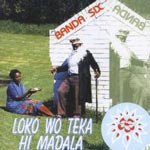
Information on Memela, like his records, is hard to come by and much of what I have gleaned below has been sourced from various blogs, auctions and the research of Yvonne Huskisson.
Composer, guitarist and later producer for WEA Records in South Africa, Almon Sandisa Memela was born in Donnybrook, KwaZulu Natal in 1936. His first guitar was homemade, but his parents were not supportive of his musical endeavors and so he taught himself to play on borrowed instruments. After briefly working at the United Tobacco Company in Durban, Memela moved to Johannesburg in 1956 to work on the mines. While there he sought to take guitar lessons at the legendary Dorkay House in 1958. The three-storey education and performance centre was purchased by Union Artists (with proceeds from the 1954 farewell concert for anti-apartheid activist Father Trevor Huddleston) and became a fulcrum for artists to meet and share ideas. As it turned out, Memela, rather than becoming a student was asked to teach the guitar lessons!
Memela made his first recordings in 1959 and his early career included band work with the United Artists’ productions of King Kong, In Township Tonight and Mhobelo as well as background music for the Jamie Uys film Dingaka. His first recording as composer was the track Nozizwe with the Travelling Singers in 1960. In 1963 his work began shifting toward instrumentals exclusively—interestingly, the same year that he formed his group, Almon’s Jazz Eight.
The Jazz Eight recorded and performed throughout the 60s and 70s (listen to their HMV 78s in the Ballantine Archive) and the line-up included amongst others, future Drive members, Henry and Stanley Sithole (who joined the group around 1966) and Bunny Luthuli (in 1968). In 1969 the Sithole Brothers formed the Heshoo Beshoo Group before they and Luthuli established the Drive in 1971. In the mean time Memela and his group The A.M Stragglers recorded Soul Bandit (1969, Little Giant, G2).
Memela is remarkably versatile and his style shifts from soul jazz with the Stragglers to bump jive with Abafana Bamaswazi (on Highway Soul and the Swaziland Likwindla Festival, both 1977); from straight mbaqanga on some 45s to the rich afro funk textures featured on Funky Africa (1975, Atlantic, ATC 9583).
In the world of eBay, Funky Africa has been elevated to “holy grail” status making this rare album even harder to come by and excessively expensive. The album is tight and excellent but we might reserve the title of “holy grail” for Memela’s even rarer album Broken Shoes (1976, Highway Soul, HSL 2009)… or at least until we listen to it!
DISCOGRAPHY

AFRICAN BUBEZI & THE CANARIES
Uyephi Mtanam / Lecherry Uguluva
1962
Gallo, New Sound
GB 3354ALMON’S JAZZ EIGHT
Don’t Shout / Go Back
HMV, 78 rpm
JP 978, OAS 2450/1
(from Ballantine Collection)
ALMON’S JAZZ EIGHT
Durban Train / Take It
HMV, 78 rpm
JP 981, OAS 2454/5
(from Ballantine Collection)
ALMON’S JAZZ EIGHT
Uthini Nzimande / Isicelo Sami
HMV, 78 rpm
JP 1001, OAS 2486/7
(from Ballantine Collection)
 JUMPING BEANS
Return Journey / Wintertime
1968
HMV, 78 rpm
JP 1123
 THE A.M. STRAGGLERS
Soul Bandit / Stragglers
1969
Little Giant, 45 rpm
L 1
(from shindiggit)
 THE A.M. STRAGGLERS
Soul Bandit
1969
Little Giant, 33 rpm
G 2
(from Electric Jive)
 ALMON’S JAZZ EIGHT & THE SWEETHEARTS
Lord Release Me / Darling I’ve Got You
1972
HMV, 45 rpm
JP 1309
 ALMON MEMELA
Funky Africa
1975
WEA, Atlantic, 33 rpm
ATC 9583
 ALMON MEMELA
Dlala Mgedleza / Guga Sthebe
1976
WEA, Sondela, 45 rpm
SLB 194
 ALMON MEMELA
Broken Shoes
1976
WEA, Highway Soul, 33 rpm
HSL 2009
 VARIOUS ARTISTS + ALMON’S JAZZ EIGHT
Highway Soul
1977
WEA, Highway Soul, 33 rpm
French pressing, S 95006
 VARIOUS ARTISTS + ALMON’S JAZZ EIGHT
Swaziland Likwindla Festival
1977
WEA, Atlantic, 33 rpm
ATH 4011
(from Matsuli)
HMV, 78 rpm
JP 978, OAS 2450/1
(from Ballantine Collection)
ALMON’S JAZZ EIGHT
Durban Train / Take It
HMV, 78 rpm
JP 981, OAS 2454/5
(from Ballantine Collection)
ALMON’S JAZZ EIGHT
Uthini Nzimande / Isicelo Sami
HMV, 78 rpm
JP 1001, OAS 2486/7
(from Ballantine Collection)
Return Journey / Wintertime
1968
HMV, 78 rpm
JP 1123
Soul Bandit / Stragglers
1969
Little Giant, 45 rpm
L 1
(from shindiggit)
Soul Bandit
1969
Little Giant, 33 rpm
G 2
(from Electric Jive)
Lord Release Me / Darling I’ve Got You
1972
HMV, 45 rpm
JP 1309
Funky Africa
1975
WEA, Atlantic, 33 rpm
ATC 9583
Dlala Mgedleza / Guga Sthebe
1976
WEA, Sondela, 45 rpm
SLB 194
Broken Shoes
1976
WEA, Highway Soul, 33 rpm
HSL 2009
Highway Soul
1977
WEA, Highway Soul, 33 rpm
French pressing, S 95006
Swaziland Likwindla Festival
1977
WEA, Atlantic, 33 rpm
ATH 4011
(from Matsuli)